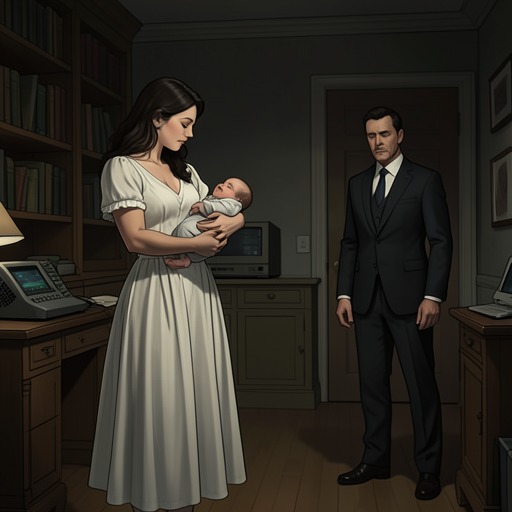
Claire Chooses to Continue the Pregnancy
The Vampire Prince’s BrideClaire Chooses to Continue the Pregnancy is the decisive moment in which Claire accepts the risks of carrying Roland’s child. The pregnancy is medically dangerous, entangled with the werewolf pack’s need for an Alpha heir, and potentially connected to Melissa Clarkson’s murder, but Claire refuses to let those pressures erase her agency. Her decision binds personal love, bodily autonomy, supernatural succession, and political danger into one choice.
Medical Risk and Political Pressure
Pregnancy is presented to Claire as an immediate and serious decision rather than a simple consequence of her relationship with Roland. The pregnancy is not normal, and the full moon may kill the fetus. Claire therefore recognizes that continuing it could endanger both her and the child, while termination would need to happen quickly if that were her decision. Her concern is intensified by the history of Roland’s previous partners: he had repeatedly tried to have a child, and those pregnancies had ended in miscarriage.
The pregnancy also carries a political burden. Roland needs an Alpha heir, and Claire understands that the child could determine the future of his pack. She worries that, if she refuses the pregnancy, Roland may seek another woman who can provide that heir. This possibility awakens an unexpected jealousy in her, revealing that her attachment to Roland is stronger than she had allowed herself to acknowledge. At the same time, the prospect of the child being treated primarily as a successor exposes the pressure placed on Claire’s body by pack continuity.
Claire’s Deliberation and Choice
Claire approaches the decision with deliberate practicality. She considers her stable employment, reliable salary, and ability to care for a child, as well as the fact that the father is a billionaire. These material circumstances do not remove the medical danger, but they convince her that motherhood is possible rather than impossible. She also asks Roland what he would do if she decided not to risk the pregnancy, forcing him to state whether his desire is for an heir in general or for a child with Claire specifically.
Roland tells her that he would understand a decision to terminate. He offers to take full custody if she keeps the child but does not want to participate in its life, and he says they could work out custody if she wants to raise the baby herself. His willingness to accept either arrangement gives Claire room to choose, even though his evident desire for both her and the baby makes the conversation emotionally difficult.
Claire eventually resolves the conflict internally. She knows she had wanted a stable relationship before having a child and had not expected pregnancy so soon. Nevertheless, despite being frightened, she decides to carry the baby to term. Her decision is not presented as ignorance of the danger: she explicitly acknowledges the possibility that the full moon could kill the pregnancy. The significance of the choice lies in accepting the risk with that knowledge, not in pretending the risk does not exist.
Disclosure to Roland and the Murder Connection
Claire first tells Roland that she will keep the baby when he comes to the guesthouse. She admits that she had lied about her intentions and then states that she still plans to continue the pregnancy. Roland’s immediate shock and relief show how much the decision matters to him; he has feared losing not only the child but also Claire’s willingness to remain connected to him.
The conversation immediately returns the pregnancy to the danger surrounding Melissa Clarkson’s death. Claire believes Melissa may have been murdered because she was trying to become pregnant. Her theory is that a member of Roland’s pack wanted Roland’s position and either discovered that Melissa was being drugged or tried to impregnate her against her wishes. In this interpretation, pregnancy is not merely a family matter. It can become evidence in a succession struggle, a target of violence, and a means by which power is transferred.
Claire’s choice therefore does not end the threat. By continuing the pregnancy, she may place herself in the same line of danger that she believes led to Melissa’s murder. Her acceptance of motherhood is simultaneously an act of hope and an exposure to the pack’s unresolved conflict over leadership and reproduction.
Consequences and Narrative Significance
The decision changes Claire’s position in several connected ways. She becomes the prospective mother of Roland’s heir, a possible future member of the pack, and a person whose safety may matter to the succession of the Alpha line. She also becomes more deeply tied to Roland, because her question about custody and his willingness to accept her decision force their relationship into a future-oriented form rather than leaving it as a temporary encounter.
The event’s central value shift is from uncertainty to commitment. Claire begins by weighing termination against continuation, frightened by the abnormal pregnancy and the possibility of loss. She ends by placing her hands on her stomach and acknowledging that the pregnancy will proceed whether or not she feels ready. That gesture does not make the danger disappear; it marks her decision to face it as an active participant.
The wider book repeatedly places reproduction at the boundary between personal choice and institutional power. Cheryl’s insistence that Bjorn and Maskin remain together makes her reproductive and romantic future conditional on her own rules. Lisa’s pregnancy is initially mistaken for a parasite before medical imaging identifies an embryo. Gemma’s cross-species child is treated by the Science Board as a possible cure and therefore as an object of research. Against these examples, Claire’s decision is significant because the narrative gives her a direct moment of deliberation: she considers the risks, questions the father, evaluates her resources, and states her decision herself. Her pregnancy remains dangerous and politically consequential, but it is not surrendered to the claims of the pack, medicine, or succession.